The blight of open pit mining  

Posted by Nick Ballesteros in

I was browsing magazines at the Wellington City Library awhile ago when this news article on the cover page of Canada's ThisMagazine caught my eye. It was a story on the open pit mining at Mt. Canatuan in southern Mindanao. Taking on the disaster at Marinduque's Marcopper which was operated by Placer Dome, it is disheartening to learn that it is happening all over again at Mindanao. The health of people in the area are in danger due to poisoning, the effect of which not only affects this generation but in the next as well as mothers pass on dangerous minerals to their unborn child.

And to add insult to injury, the supposed employment possibilities for the local folk are not happening. Open pit mining is really work for heavy machinery, and not a lot of people are needed for such an operation. And so, as the profits are carted off Philippine shores, the local fishing and farming industry takes a hit, and the poor becomes even poorer, if that is even possible.

Read more about this in Alex Felipe's All that Glitters article at ThisMagazine.


Read more...

Do the Green Thing: Stay Grounded  

Posted by Nick Ballesteros in


This month's Do the Green Thing "challenge" is to stay grounded. That means no boarding the plane for the holidays. Planes can churn out loads of C02 in the atmosphere. Sure, lots of cars also do. But in this case, the C02 is dumped high up in the atmosphere, giving it a lot of adverse effects. If you avoid that plane trip, you save as much C02 as a year's worth of heating and electricity.

So head on over to Do the Green Thing and make your C02 savings count!


Read more...

Build a worm farm  

Posted by Nick Ballesteros in

One of the nice things here in New Zealand is that gardening seems to be a popular pasttime, with many areas green with trees, lawns and abuzz with colours from flowers. Access to seedlings and gardening materials are readily accessible through gardening specialty stores and shop sections.

We saw this worm farm in Bunnings Warehouse in Porirua. Kits such as these make recycling even more interesting, educational, and engaging.


Read more...

Merry Christmas, from my family to yours  

Posted by Nick Ballesteros


Read more...

The biggest full moon of the year  

Posted by Nick Ballesteros in


This news is already a wee bit late, but the biggest full moon of the year was spotted last 12 December, as reported by NASA. Were you able to see it? Apparently, it was best viewed from the Northern Hemisphere. Sadly I was not able to see it as well. :-(

But a good friend shared his photos in our mailing list and I was amazed by the detail he was able to capture of the lunar surface using a Nikon D90 with 18-200 VR lens. I asked permission to post it here. The moon was no longer at its fullest but it's still an aswesome sight. Enjoy!


Photos courtesy of John Paras. Check out his photography work at zenfolio.


[cross-posted at www.nickballesteros.com]


Read more...

Go to town with your recycling  

Posted by Nick Ballesteros in


Read more...

Rubbish collection, New Zealand style  

Posted by Nick Ballesteros in , ,

One of the first things we learned about living in New Zealand is their rubbish collection. Rubbish is more commonly known in our country as garbage. So if you're having a conversation and you hear them declare that what you're saying is a load of rubbish, it's not a compliment. Bwahuhuhu!

For an orderly rubbish collection, you need two things: a council bag and a kiwi bin. Council bags are huge, yellow plastic bags where you place your non-recyclables in. It costs around $9.00 for 5 pieces, and can be bought at grocery stores (ask for it at the counter). You are allowed to load up to 15kg per bag. More guidelines are printed on the bag itself.


Next is the kiwi bin. If you're renting a flat, your landlord should give you one. But if it's not available, you can buy this for $10 at the Library. It's a green, plastic container into which you place your recyclables such as paper and bottles (plastic and glass).


There is a schedule for rubbish collection; you need to ask about this from your landlord, neighbor, or from information centers such as the library. In our case, it's on Mondays at around 8:30AM. We bring out our rubbish after 5:30PM on Sunday. The collection team for general rubbish collection is different from the recyclables team.

I believe that this method of rubbish segregation works because you have a visual of where to put your recyclables and non-recyclables. And since collection is once a week, people are motivated to dispose properly of their refuse or else they'd have a smelly kitchen or backyard.

Supporting the rubbish collection scheme are campaigns to make your own compost out of biodegradable stuff from the kitchen. Some gardening stores even offer tutorials and you can buy your supplies from them to start and sustain a worm farm of a compost heap.

The council bag and kiwi bin concept may not work in our country, but we can still follow a similar theme in garbage segregation and actively support backyard composting.

[cross-posted in watson.online/]


Read more...

The Starbucks Irony  

Posted by Nick Ballesteros in

Starbucks is one of the more popular cafes around, and it has launched initiatives for providing clean, drinking water to impoverished countries. An article was written about this in USA Today.

The irony is, the same company is being criticized for wasting huge amounts of water. Here in New Zealand where a large number of areas still has drinkable tap water, this is indeed cause for alarm. Starbucks outlets have something called a dipper well where water continously flows during work hours at the rate of 10 liters a minute. This translates to 113 million liters a year in New Zealand alone. Read more about this at Stuff.

While the water left running is apparently for sanitation reasons, there has to be another way to clean up utensils and not let the milk foam build up. We do not have a limitless supply of drinking water.


Read more...

eDay 2008  

Posted by Nick Ballesteros in , ,


Started in 2006, eDay was a community initiative with the goal of emphasizing the environmental impact of electronic trash. Many of these include outdated computers and printers.

eDay provides a venue for an organized effort to pool resources in collecting electronics trash and informing the public that such waste does not belong in landfills where they can pose hazards. Many of these can still be reused and recycled.

eDay is currently being observed in New Zealand only.


Read more...

Leaving on a jet plane...  

Posted by Nick Ballesteros

I have not been able to update recently because we are in the midst of preparations... my family and I are bound for Wellington, New Zealand on Sept 16. Malapit na... wish us luck! More information here


Read more...

Escape to Cagbalete Island in Mauban, Quezon  

Posted by Nick Ballesteros in


Where can you be so close to nature that you can't help but feel awed at the sight before you?

Where shells big and small are not just washed-up remnants of a life they once lived, but are instead teeming with crabs seeking their protection? Where fish hastily glide by while you tread on their waters, and brittlestars take refuge amongst the rocks as the water recedes in tune with the low tide? Where else does the ocean become calm, breaking the surface with only the slightest ripple?

Where else, but in Cagbalete Island!

Cagbalete Island is part of the expansive Quezon province of which my wife also hails from. Last weekend saw us at this wonderful island, a place so remote from the main islands that it has no electricity and yet it can be reached in about 7 hours by land and sea (at least, that's what our experience was; in some sites the trip is . Our meeting set at 3AM, I did not dare sleep as I might miss the trip. I was at already at Wendy's Buendia a few minutes early but some even arrived much earlier. Our party complete, we headed for the bus terminal.

Here is our itinerary in a nutshell:
3:00 AM - Met at Wendy's Buendia, then proceeded to JAC Liner (P216.00 each)
3:30 - Bus moves for Grand Terminal
6:15 - Arrive at Grand Terminal, take a ride at the Mauban mini bus (P50.00 each)
6:30 - Mini bus leaves for Mauban (there's a mini bus departing every 30 minutes)
8:00 - Arrive at Mauban, time to go to market for supplies!
Don't forget to buy ice! For your fish and meats.
Villa Cleofas has ice boxes.
Electricity is available at Villa Cleofas at 6:00PM - 1:00 AM
You may just walk to the bangka (ask for directions from the locals), or rent a tricycle (P30.00 per person)
Go to the bangka as early as possible to get seats you want (P40.00 each)
Tip the persons loading your things if you ask for their help. They are a jolly, helpful lot.
10:30 - Bangka leaves for Sabang port in Cagbalete Island.
11:30 - Arrive at Sabang port
There is also ice here and stores in case you forget something.
Villa Cleofas had a bangka fetch our supplies and two of our company
was also able to hitch a ride at the bangka. P200.00
The rest trekked across the island for 20 minutes non-stop.

Welcome to Villa Cleofas!

The Grand Terminal

The boat transports not only people, but also goods. It was exciting because I do not experience this everyday and you get a feel for local life. Their language is the deeper version of Filipino but you'll manage.

The island is in view!


Sabang port. A dinghy will escort you to shore (no charge)

Trek time!

Villa Cleofas! to the left is the big cottage where we stayed, at right is the dining area. We cooked our meals using their gas range and their utensils and plates with a rental fee of P150.00 per use. We were charged 30 pesos per head for entrance fee as well. If you don't feel like cooking, ask Manang to cook for you and tip her. She cooks real well.
Low tide was upon us when we arrived...
Low tide here is dramatic. The water literally disappears!


I was at the shore when I took this shot. Look how far away that person is already, and the water is still so shallow!

The black speck beyond is bonsai island, which can be reached by simply walking at low tide.
Stranded boats
The sea is alive! Hermit crabs, polyps, brittle stars (pictured below), fish, and plants abound. You have to tread around carefully and observe them. It's wonderful just walking around looking at the abundance of life.
If you want to take a bath at the sea and you are at Villa Cleofas, I suggest that you don't swim in this area. Too many living things taking residence here. Instead, turn left from Villa Cleofas, walk 800 meters, and you will get to a river mouth! The river is waist-deep.

Cagbalete as viewed from the cottage.


My comment about the place?
It is certainly different from Boracay and Puerto Galera, where nightlife and abundance of people and entertainment are the highlights. Also very different from regular beaches where all you get is sand and water. Cagbalete Island is something else. It's quiet, you get to commune with nature, here time takes a slow turn and you can enjoy the peace and quiet.

The last time I have ever been to a beach with so much life teeming around me was in Marinduque 14 years ago. I was on vacation all by myself and I was staying with my grandmother. I would go to the beach almost everyday for 2 weeks and swim around by my lonesome. I loved it. The water so clear, and in the afternoons, the setting sun would cast rays of light underwater....

I felt the same thing for Cagbalete, although I did not have the chance to swim a lot. I would have wanted to stay longer.

The Villa Cleofas staff are also very kind and helpful. Their website is at www.cagbalete.com.

These photos came from my iPhone. I will post more photos from my friends' cameras some other time.

[cross-posted in watson.online/]


Read more...

Birdwatching, anyone?  

Posted by Nick Ballesteros in

Ever wanted to take up an alternative hobby that requires outdoorsiness without the rigours of jogging or trekking? Why not take up birdwatching?

Luckily, an organization for this hobby is now alive and well in Manila. Be amazed and discover how flourishing communities of birds live in and surrounding areas of Metro Manila. There's nothing like going out there and having a first-hand experience at nature appreciation to see how Nature enriches our lives and what we must do to ensure that these will still be around for the appreciation of future generations.

For more information on birdwatching and membership guidelines, visit the Wild Bird Club of the Philippines at http://www.birdwatch.ph.


Read more...

Katibawasan Falls in Camiguin Island  

Posted by Nick Ballesteros in

Camiguin is truly blessed with rich natural resources, and it has a lot of water-themed tourist spots that entice locals and guests alike to dip into pools and spend the leisurely time away from the hustle-bustle of city life.

The Katibawasan Falls is located at the foot of Mt. Timpoong at Mambajao. There is a wide, parking area near the entrance where souvenir stalls vie for your attention to purchase shirts and trinkets.

Upon paying a minimal entrance fee, a short walk to the falls increases your anticipation as you hear the roaring waters and catch glimpses of the falls between foliage and trees.

The path eventually takes you to a ridge and beyond, a breathtaking view of Katibawasan Falls!


It's a majestic sight! Measured at a drop of 250 feet, I have never seen a waterfall with such height! Cameras clicked feverishly as people scrambled for the best location.

Actually, we did not intend to swim but the water was so inviting! And so take a dip we did.

It was c-c-c-c-c-c-c-c-cold-d-d-d-d-d-d-d.

Eventually you get used to it somewhat, but then when you leave the pool, it's even c-c-c-c-c-colder-r-r-r-r-r-r.

My emote moment. Heh

It made me wonder how the top of the waterfalls look like. It's amazing how the water topples off the mountain wall like it's coming from nowhere. It was beautiful, enchanting, and relaxing all at the same time.


Related Links:
Wonderful photos at Lino Photography
Camiguin Island information by the Hawaiian WebMaster

[cross-posted in watson.online/


Read more...

Life finds a way  

Posted by Nick Ballesteros in

My parents planted these onions and to protect them from the chickens, they surrounded these with some bits of wood. Lo and behold, the sticks have started sprouting leaves as well! In the words of Ian Malcolm (Jurassic Park), life finds a way.


Read more...

DoTheGreenThing's July Task  

Posted by Nick Ballesteros in , ,


The task for this month for DotheGreenThing members is quite easy to do: when you're done using an electrical appliance, uplug it! Putting it on standby doesn't help either, so make sure you turn it off, or better yet, unplug it.

So what things do we usually take for granted that's just plugged in there on standby while we think it's not guzzling any electricity?

1. The computer. Yep, we love using the computer in the office and at home. And there's quite a considerable amount of time that it spends just sitting there, playing a screensaver no one's watching anyway. Better unplug the thing. You save the life of the laptop's battery in the long run, and you save up on electricity bills at home. Take note of even the peripherals: printers, speakers are the most common.
2. When you are nearly done with ironing clothes, unplug it. There's enough heat left for the hankies.
3. Microwave ovens. When you see the time flashing away, it's feeding on electricity.

About the only thing I can think of which cannot be unplugged is the ref. What an awful waste it will be for spoiled food.

So go on ahead and register at Do The Green Thing. It's a fun way of being green, and you can count your C02 savings!


Read more...

A snail on a rainy day  

Posted by Nick Ballesteros in

A snail on a rainy day near my parent's home in Crystal Cave in Baguio City, Philippines. Something so simple, and yet something increasingly not so commonplace anymore.


Read more...

Recycle your cans  

Posted by Nick Ballesteros in , ,


Cans are one of the more useful things that can have a second life after it has served its primary purpose. A little creativity can go a long way.


Did you know... that it takes a can of soda 20 years to recycle itself (which basically means rusting away and turning to dust). A lot of these end up in the landfills. Let us do our share in recycling cans.


I learned the above trivia from the TV Show Planet Green on National Geographic.

Here are some things you can do:
1. Sell it. Soda cans are bought by the kilo.
2. Bigger cans may be converted into pots for your plants.
3. Decorate medium-sized cans with art paper and use as pen containers. Just make sure that it's the kind without sharp edges.
4. Cover the milk can and slit a hole through its lid. Voila! A coin bank.
5. Punch a hole through the bottom of two cans, tie a cord through these to interconnect these cans, and you get a phone system!
6. Buy your powdered milk in foil packs and re-use the cans (although the foil packs become unwanted trash too. Hmmm).

With a bit of creativity, let's reduce the amount of trash we produce, starting with cans. And it's even fun doing projects with your kids!


Read more...

A Salute to Gov. Vilma Santos-Recto  

Posted by Nick Ballesteros in ,

When I saw the news some time ago about Gov. Vilma Santos-Recto initiating actions for the removal of the unused fish pens in Taal Lake. She makes complete sense in this action, because she was not only thinking of the rehabilitation of the lake itself, but of the livelihood of the people as well. This is in contrast with DENR Head Atienza who wants to dismantle all the fishpens in one sweep. Where will that leave the people who are dependent on the lake? It's just making one problem while trying to solve another.

She revealed in the TV interview that the movement in the local and national environmental agencies were slow to take action and so she initiated the movement. But she will only have the unused fishpens dismantled at this initial stage, and is likewise in active participation with local groups to find alternative sources of livelihood for the people.

And although the Tawilis, a freshwater sardine found only in Taal Lake and is one of only 2 species of its kind worldwide, was not mentioned, they might not know it but this will help the fish thrive in the lake. The Tawilis is currently a threatened species due to overfishing and setting up of fish farms in the lake, competing with the finite food supply of the Tawilis.

I salute you, Gov. Vilma Santos-Recto, for your environmental actions!

Related link: "Vilma Santos seeks other livelihood for fish cage operators" at inquirer.net


Read more...

Manila Ocean Park  

Posted by Nick Ballesteros in

We visited Manila Ocean Park last April. It took me some time sto blog about this because this was also the time I sorely missed my Canon camera, which went kaput only a few weeks prior to this adventure. My brother just arrived from Jeddah on this day and we decided to visit some noteworthy places before we head out to Baguio, where he will surely be staying put for the rest of his vacation.

Each adult costs 400 pesos. Whew! That's a lot of money. But if you think about it, it does not cost as much as the ones in HongKong and Singapore. Well, perhaps it's because those abroad have carnival rides and other attractions in them whereas ours is an oceanarium with some human conveniences built in such a hotel, mall, and restaurant.

Still, even at 400 pesos per head, the place was jampacked! We had to wait two hours to finally have our tour. Here are some photos to tell the rest of our story.

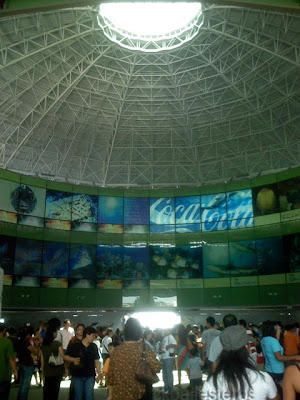

The first stage is the outdoor aquariums.
Here, the guests can touch the starfish.
Nemo (a clownfish) and Dory (hmm... forgot what species she is) are very popular with the kids and adults alike. Upon entering, everybody would wonder aloud, "where's Nemo?" and shrieks of delight would come from people who sees the clownfish.
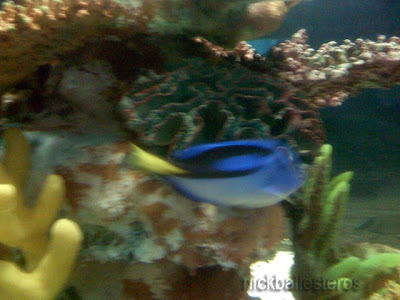
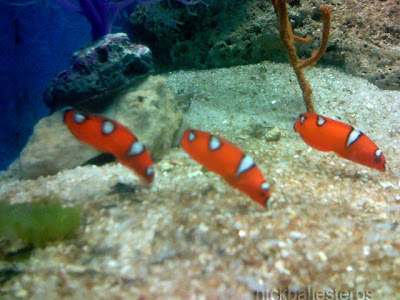
Very beautiful collection. This one below, was amazing. It was huge! Its tank was kept cold.
The nautilus! One of my favorites. Did you know that this was the inspiration for the submarine?
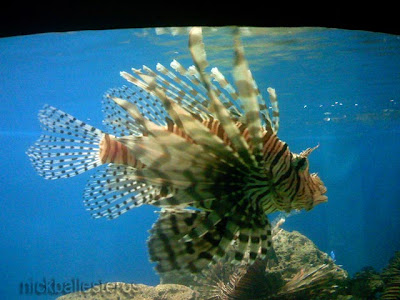
The deadly lionfish.

There was this section of the park where huge aquariums are located and schools of fish swim effortlessly in groups. It was mesmerizing.
This photo is dark because flash photography is not allowed. And I think I just used my iPhone for this one. When you enter this tunnel, you can no longer go back.

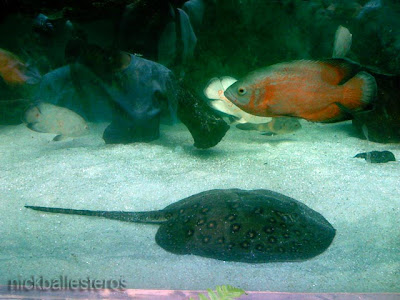
This place goes through the largest aquarium in the park, with sharks and large fish and stingrays swimming above and beside you. Beautiful.
Now I know why the parks in HongKong and Singapore had a moving pathway in their tunnels. So that people wouldn't linger. As it happened here, the people stayed for the longest time in the tunnel watching the fish swim everywhere, making this the most congested area.

We were lucky! A couple of divers went in to feed the stingrays and a shark of sorts. The stingrays would glide by the diver and they would insert the fish into the mouth. I think it's the poor galunggong that's the meal of the day.
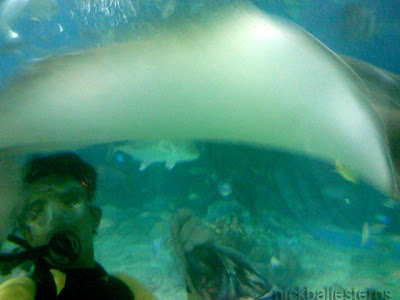
The Manila Ocean Park is quite a spectacle. I am glad that we have one now.

But of course, some minor quirks:
1. As with the other bloggers, I am not too happy about the starfish-handling section. For one thing, nature appreciation and conservation is all about letting them be. I think that letting the people just touch and get those starfish out of the water is sending the wrong message: that we can simply catch these starfish when we see one in the wild.
2. The aquariums at the open air area were quite blurry with green algae growth. I think it's because they're under the sun, and it's making the algae grow more rapidly than anticipated. Isn't this bad for the fish?
3. I was supposed to say, fake or dead corals as added decor (whoops! there, I said it) but understandably, it will truly be very difficult to maintain live corals in aquariums in such a huge environment.
4. I did not manage to look at the restaurant's menu but if there are fish in it, then wouldn't that be ironic?
5. The place was not yet finished at the time of our visit.

It will be great to see the place completed and surely more attention will be focused on nature conservation. But overall, we enjoyed the trip.

[cross-posted in watson.online/]


Read more...